Post-Election Mythorializing At the Wall Street Journal

“The battle for liberty begins anew this morning.”

Wall Street Journal editorial, Nov. 7, 2012

It’s been a month or so now since the the Romney-Ryan-(Ayn) Rand ticket’s defeat. Ultimately, the Republicans were brought down by the moral Taliban, the Tea Party, and the plutocrats–the ranks of their party most out of touch with a changing America.

Since election night, undaunted and unchastened as ever, of course, the Wall Street Journal’s editorials have been doubling down on a few key themes left over, oh, let’s say, from the Reagan years: class warfare, ending all taxes if possible, unfettered free markets, and the inherent evils of government. Money quotations:

The great mistake of Mr. Obama’s first term was putting his social and political agenda above nurturing a faster economic growth. ( “Obama’s Real Fiscal Problem,” Nov. 30)

Mr. Obama has humiliated House Republicans and punished the affluent for the sheer joy of it. (“The Hard Fiscal Facts”, Nov. 11)

Imagine the gusher of revenue the feds could get if government got out of the way and let the economy grow faster. (“The Hard Fiscal Facts”, Nov. 11)

In this era when envy trumps growth, the government is raising taxes on thrift, investment and risk-taking in the name of fairness and to finance more government spending. No one should be surprised when there are fewer dividends and capital gains to tax. (“The Great 2012 Cashout”, Nov. 28)

“American prosperity is best served by letting business exploit as many opportunities as possible…” (“Energy Economics In One Lesson”, Dec. 6)

To be fair, there are a few more contemporary obsessions: fracking, school choice (“the great civil rights issue of our era”), teachers’ unions (“the Evil Empire”), and, of course, Obamacare.

One of the best Obamacare editorials (“Hope and Exchange,” Nov. 27) talked about Obamacare as the “re-engineering” of the health care system,” being “rammed” down the throats of the throats of Republicans. It especially extols Utah’s medical insurance exchange, organized around the trifecta of Republican dogma: defined contribution, consumer choice, and free markets. In other words, coverage caps, the end of all state insurance regulation, and no cost controls whatsoever.

images

The more these guys change, the more they stay the same.

Glossary I

One key component of a running rhetorical analysis aimed at denaturalizing political  language is the constant revision of a working glossary. Readers are invited to contribute current glossary items. Below are some from the mid-80s.

Politiglossary, 1986

Words are never innocent, but the art of political rhetoric is to make them invisible, taken-for-granted,  natural, like oxygen. Reading a Journal editorial is actually an exercise in cryptography, and here are some key terms and phrases from editorials written from October ’85–October ’86 likely to be recycled for the next two years.

Acid Rain, Toxic Waste, Agent Orange, Nuclear Hazards, Product  Liability, Monopolies: Myths or theories, used by “environmentalists” and “activist judges” to harass and maim American industry.

The Agenda of American guilt: Vietnam and Watergate. Now abolished. No more Mr. Nice Conscience.

Arms Control: An illusion well-lost. Replaced after Reykjavik by a tripartite strategy to counter the Soviets: SDI, total verification arrangements, and increased pressure on the Soviets to end internal political repression. “Rearmament” has replaced “disarmament”.

 James Buchanan: Nobel laureate “public choice” economist always used to prove how Democrats are self-serving hypocrites who need reigning in by a balanced budget amendment.

 Budgetary Restraint: Giving the President the line-item veto. Any Presidential budget decisions are, by definition, “restrained”.

Chernobyl: Short for Soviet incompetence and deceit, never a symbol for the risks of nuclear power.

 Colorblindness: The death-knell of affirmative action. Related to “constructive engagement”: let the chips fall where they may, “naturally”.

 The Commander-In-Chief: A President who end-runs Congress.

Competition: The one unfailing, trustworthy human engine for improving the world.

 Congress: Nothing more than “a machine for extracting money from the broad population and passing it out selectively.”

 Constructive Engagement: In administration terms, a euphemism for propping up an unsavory regime. “Constructive” is actually a redundant intensifier, since any such “engagement”  is by definition “constructive”–a marriage of convenience.

EIS’s: “Silly-putty”

Entrepreneur: The highest of human aspirations.

Environmentalists: Unreasonable, self-seeking hypocrites who use the smokescreen of a love of nature to disrupt corporate profits and create jobs for themselves. Like South Africa, “the environment” should be benignly neglected.

 FDR: Precursor of Ronald Reagan. Meant only as shorthand for strong leader, not for FDR himself or his policies. Always mentioned as the previous president to have affected a major political revolution in America. Details left out.

 Fault:That which cannot be proven in a liability suit, or else that which lies with the consumer; thus should be the basis of tort reform.

 Incentive and Margin: The two key terms of supply-side economic theory, a value theory of labor. What it takes to give the already-rich the incentive to do additional work, so they can help the poor.

 Internal Affairs : To be differentiated from foreign influences. Any nation we are favorably disposed towards, such as South Africa, should have inviolate internal affairs. Any nation we are opposed to, such as the Soviet Union or Nicaragua, has no internal affairs because they are dictatorships. Akin to the Kirkpatrick Doctrine differentiating authoritarian from totalitarian regimes.

 Judicial Restraint and “Separation of Powers”: That philosophy practiced by Reagan-appointed judges, as opposed to “activist judges”. Restrained judges have an innate sense of the Constitution’s “original intent”: they have its essence in their sights. Separate Presidential powers come in the form of the line-item veto and the repeal of the War Powers Act. By definition, any decisions rendered by the Rehnquist court which the Journal agrees with will be following the spirit of the Constitution; all others will be “activist” interpretations. Like “activism,” “interpretation” is out.

 Mutual Assured Destruction: The “horrible concept” that American arms negotiators followed for a generation, now replaced by the pacific notion of strategic defense, which “does not threaten, only protects.”

 Open Market Reform: (a.k.a. The Baker Plan) Get tough with foreign nations by making them abolish regulation, price controls, progressive tax structures, currency revaluations, land-reform programs, trade barriers, and all state-run enterprises; go to the gold standard to “stabilize capital assets”; make the world safe for U.S. corporate investment abroad; enrich foreign elites as the only way to lead the huddled masses out of poverty.

Performance-oriented: The opposite of regulated, as in the sentence, “If the Pentagon is to be performance-oriented instead of constantly looking over its shoulder, Congress will have to stop treating it as a gold mine of scandals to publicize and exploit.”

Privatizing: Making a buck out of anything and everything. Any failures would be due to government regulation. New target: air traffic control.

Productivity: Anything the that creates “financial assets”; by contrast, the poor are “unproductive” and therefore self-victimized.

The Rich: Thanks to supply-side economic laws, the best friends the poor could ever hope for.

Risk: That which entrepreneurs take in order to be productive. “Moral issues,” (always in quotation marks) like South African sanctions or environmentalism are “unproductive” because risk-free to those who entertain them.

SALT-II: The last lingering Carter guilt-trip, now well behind us.

SDI: As the first US arms initiative that gets the Soviets off-balance, SDI represents the long-awaited reversal of Vietnam. Should be deployed immediately over America, Israel and Europe. The litmus test for U.S. patriotism.

San Francisco: The Other. Not a part of America. As in “San Francisco Democrats.”

Self-control: The keystone of New Right morality, best induced by such authoritarian state controls as drug testing, banning of contraceptives, and censorship.

Thomas Sowell: used to attack affirmative actions and explain why all blacks ought to be Republicans.

Static and Dynamic Analysis: The “static analysis box” is economic forecasting that doesn’t take supply-side growth into account. Thus supply-side policy can always be justified by “dynamic analysis,” which assumes the alleged but chimerical growth long promised by supply-siders. Recessions are caused by the policies proferred by static analysts, not the failure of supply-side theory.

Too Political: Any opposition to the administration. a.k.a. “special interest” or “constituencies” or “judicial activists”.

Tough decisions: (a.k.a. “willingness to lead”): Any decision by the “Commander-In-Chief” to end-run Congress and the State Department. Leadership, like toughness, means going it alone.

Worker’s rights: Like “the public good,”or “social justice,” an example of “Marxist claptrap”. A hypocritical smokescreen for those who would maim U.S. industry. The only true workers’ ally is corporate profit

RHETORICS AND FLOURISHES: DEMYTHOLOGIZING THE WALL STREET JOURNAL

As I recently posted, I am going to begin a daily interrogation of Wall Street Journal  editorials, a practice I started long ago. This example illustrates some of the tools of rhetorical analysis that I’ll be employing.  

WALL STREET JOURNAL EDITORIAL  7-14-86: “Reagan’s Year”

“Myth on the right is well-fed, sleek, expansive, garrulous. It invents itself ceaselessly. It takes hold of everything.” (Roland Barthes, Mythologies, 148-49)

Not since the days of Teddy Roosevelt and William Randolph Hearst has such a close alliance existed between a newspaper and a president as that between the Wall Street Journal and Ronald Reagan. In the heady days of RR’s rise to power, the Journal’s editorial page was a virtual blueprint of administration policy and an early-warning system for presidential rhetoric. Since the departure of Craig Paul Roberts and Jude Wanninski from the Journal’s edit pages, and the gradual fading of the supply-side controversy from headlines, the Journal is less in the political spotlight. Yet editorial page editor Robert Bartley and his staff have perfected the outrageous ideological editorial form over the past six years. Their invectives have been described aptly by Bob Kuttner as “scornful, sneering, and Manichean.” Manichean is the key: they see themselves speaking for god-like principles struggling to control the universe. This holy war attitude gives them fire, and makes for rhetoric-with-a-vengeance, language with blood on its mind. If rhetoric may be called the art of swaying and holding an audience–identification and hypnosis–then its principle task, as French writer Roland Barthes put it in his classic Mythologies, is to create a myth by making it seem natural, a given, a “structure of reality,” as French rhetorician Chaim Perelman calls it. Since the Journal is still the creator of the reality principle for the Reagan administration, it seems useful to annotate a mid-term, mid-1986 seminal Journal editorial, using some ideas of Barthes and Perelman to illustrate how the rhetoric of the Reagan administration is created and creative.


1-Quantity masquearding as quality. Poll ratings, net worth, GNP, and corporate earnings have become fully ensconced as the bellweathers of success in Reagan’s America.Quality has been reduced to a co-efficient of power. The ’70’s emphasis on “quality of life” seems naive and innocent: not real. Numbers are no longer contextualized or seen as arguments, but are treated as somehow natural, the way things are. Even arguments are not presented as such, or even as explanations, but as statements of fact, as things that mean something all by themselves.


2- Theses built on adherence to premises: getting the audience to buy into your assumptions. The thesis of the editorial, that RR’s revolution is as permanent and far-reaching as FDR’s, depends on two main premises: that America was “in decline” under Jimmy

Carter, and, correlatively, that America has been rescued after being held hostage by the Democrats, who, like the Iranians and Soviets, affront the real America. The myth-making starts here, using paired either/orisms to create the dichotomy  defective Others (Democrats, Iranians, etc)/born American.  The pejoratives “whims of Congress” and “redistributing income,” are shorthand for anything that stands in the way of Reaganomics; the naturalized terms “economically favorable” and “most productive assets” establish the norm, which “laughs” at a whimsical and socialist Congress.


3. Using codewords to signify something beyond their literal meaning. These godwords are the essence of supply-side ideology, and always have an agenda: “incentives” are what the Democrats took away from Americans. Under Carter, it wasn’t worth it to be an American. The “margin” of incentive is what “Reagan” has restored: Americans can now put in that extra effort to earn the next dollar because incentive “is back”. Incentive lies at the margin–everything has its price and net worth. Everything is for sale, except for those whimsical few who don’t “work”.  “Work” has replaced “whim” and “productivity” has replaced “redistribution”. The Democrats are not “productive assets”.


4.Establish a concrete entity as an eternal order whose essence you are in touch with.  The electorate has been held hostage. A “political” judiciary nearly ran away with “the Constitution”. Thus a new myth is born: the new apolitical Reagan judiciary. How could judges ever have gotten “political” (tainted) when they could wrap themselves in the pure mantle of the “Constitution” (now made fixed and sure, like the sun). Reagan’s judges speak for the Constitution, automatically.


5.Simple cause and effect as the key to high melodrama. The effects: America’s decline and revival. The causes: the loss and recovery of will. Like Congress and the judiciary, the Soviets, Libyans and Sandinistas have been holding America hostage. The Other as clown, scandal or enemy. But now “punishment,” “unequivocal opposition” and  high tech have put the blues (or, rather, the Reds) on the run, “off balance”. “High tech” and “punishment” are naturally preferable to whim and equivocation.


6. Prolepsis (the inoculation), or the art of presenting objections you are eager to respond to. The Journal excels at the sarcastic prolepsis, which belittles the case by overstating it. Here, for example, by listing so many possible explanations for “Ronald Reagan’s” success, they reduce them all absurdity, and strengthen their own case for RR as FDR.


7. Relying on the emotional associations of an analogy to cover over ways the analogy breaks down. The heart of the analogy: just as FDR didn’t compromise in the face of the  Depression, a great crisis of American “decline,” neither will “Ronald Reagan” compromise with the contemporary threats to “America”: the “economic destructiveness of a steeply progressive tax system” or the “dangers of expanding federal programs”. Despite the obvious fact that the late ’70s shared little with the late ’20s and early ’30s, the inflated analogy bullies the reader into accepting the themes of decline and rebirth. At some point concrete realities, like taxation, become abstract principles, like “decline,” and are thus given a qualitatively different nature. In such a new universe, it becomes unnatural to even consider new federal programs or taxes. Such talk is “decline”.


8. Redefining key terms and appropriating them to your argument. The “Washington political establishment” astonishingly doesn’t seem to include the current administration, the Republican Senate or the new Reagan courts. Yet, somehow, these post-’79 elements have established a revolution in Washington. “Establishment” no longer means the ruling powers, but those elements opposed to RR. Journal editorialists excel at this art of turning words inside-out and repossessing (co-opting) them. Here, they have usurped the New Left’s use of “establishment” and thus mythologize themselves as Constitutional purists and outsiders, not connected with “Washington”. Thereupon, a major pitch for “Star Wars”, based on the assumption that anyone opposed to SDI is stuck in ’79, in Carteresque, unconstitutional, traitorous malaise.


9. Rationalize a wish-list by using verbs to establish values.  The line-item veto (“the only solution to the budget problem”??) would “inject discipline” by cutting all domestic (read: nondefense) funding; the gold standard would, euphemistically, “stabilize the value of capital commitments,” and SDI would “defend our military assets” and, oh yes by the way, “ultimately our population”.


10. Arguing in a circle by assuming the very thing you need to prove. The myth delivered: America has been forever remolded. Why? Because: Because assets are stabilized, incentive is restored, and “domestic outlays” are now being handled “prudently” by leaders with “discipline”. Never mind that “assets” are being defined a certain way, or that “prudence” and “discipline” simply mean adhering to administration policies.  Asserting causation doesn’t prove it, but challenging any of these “becauses” becomes treasonous. It’s a charmed circle, the winner’s circle, and anyone who doesn’t have the common sense of reality to know what prudence, discipline and stability mean, had better stop laughing. There’s been a revolution, and they’ve been left at the station. Now that’s invective.

In the Right’s Kitchen: Mythorializing At the Wall Street Journal

Written in 1987, this article of mine still helps unpacking Republican “naturalizing” rhetoric for what it is.  Going forward, my task is the daily deconstruction of Wall Street Journal’s editorials.

“Myth on the right is well-fed, sleek. expansive, garrulous. It invents itself ceaselessly. It takes hold of everything.” (Roland Barthes, Mythologies)

Late October, 1986. Dire hubris looming for the Right. Cocky and off-guard in the delirium of the success of the “Standing Tall,” High Noon spin finessed onto the Reykjavik bustup, the Right’s high priest Irving Kristol, in his 10/24 column in the The Wall Street Journal, Kristolizes the story-made rhetorical world of the Reagan presidency. Kristol’s piece, “The Force Is With Reagan,”  (awkwardly titled insofar as the administration was trying to delete all references to “Star Wars”) brings together several streams of rightist rhetoric in a particularly bald and banal conceit: “The force is with Ronald Reagan. It has abandoned the liberal bodies it once inhabited… When the Force is with you, all the breaks come your way…For the Force rewards those political leaders whose instincts and basic perception are ‘in tune with reality’–with human realities, political realities, economic realities, social realities.”

Two and a half weeks later, White House chief of staff Donald Regan: “Some of us are like a shovel brigade that follow a parade down Main Street cleaning up. We took Reykjavik and turned what was really a sour situation into something that turned our pretty well. Who was it that took this disinformation thing and managed to turn it? Who was it who took on this loss in the Senate…and managed to pull that?” Like with the Wizard of Oz, the impersonal “Force” of history that Kristol claims as kin is unmasked as the work of White House illusionists “pulling” this and “turning” that.

Kristol’s lofty “there is a tide in the affairs of men” tone is the quintessence of six years of steady Journal rhetoric about the Reagan revolution as the first major shift in American politics since FDR. The unlikely RR-FDR axis was formed early by Reagan strategists, and is used as a show-stopper whenever any debate of substance occurs, as was going on over Star Wars when Kristol wrote. As a rhetroical creation, it has more substance than shadowy events like Reykjavik or the Iranian arms “deal”. Lately, this inchoate “Reagan Revolution” is all the administration clings to.

Whatever else “history” does with this administration,  the High Reagan era, which now looks like a bygone epoch, will be seen as a golden age of political rhetoric, polemical self-creation: mythologizing on a massive scale. This was an era in which political reality was so “naturalized” by the administration in power that questioning any of its version became kin to treason. Even in the wake of severe setbacks, in its embattled rhetoric, there is no possibility of doubt: reality is rendered perfectly intelligible to all, except hypocrites, idealists, and self-servers.

And, as events at last begin to spin on their own, not so susceptible to “pulling” and “turning,”  administration apologists (in the technical sense of the term, not the pejorative one: explicators and synthesizers, not excuse-makers) increasingly come to resemble those astronomers trying to hold the Ptolemaic system together in the wake of Copernicus: ever-more eccentric orbits, epicycles, and labyrinthine explanations-within-explanations.

The fascinating thing is that this revolution-by-rhetoric has been, and continues to be, worked out in the edit columns of the Journal, hidden right out in the open, often well in advance of public debate. More importantly, as Bob Kuttner argued in The New Republic two years ago, The Journal, with its “scornful sneering, and Manichean” editorial tone, has revivified political polemic and invective to a degree, and has much to teach tamer editorialists. It’s damned fun to read this stuff: a morning shot of bile.

Manichean is the key: they see themselves speaking for god-like principles struggling to control the universe. This holy war attitude gives them fire, and makes for rhetoric-with-a-vengeance, language with blood on its mind. If rhetoric may be called the art of swaying and holding an audience–identification and hypnosis–then its principle task, as French writer Roland Barthes put it in his seminal Mythologies, is to create a myth by making it seem natural, a given, a “structure of reality,” as French rhetorician Chaim Perelman calls it.

A close reading of Journal editorials from October, 1985 to October 1986 spotlights some recurrent past themes worked out over time and retooled for the next two years of brutal rhetorical slugfests. Now that the administration is on the defensive, the rhetorical devices of the Journal’s editorials are more transparent, and thus offer a wonderful opportunity for denaturalizing analysis of political rhetoric.

More importantly, perhaps, using some basic tools of rhetorical analysis helps us read any political rhetoric, left, right, or center. Political rhetoric is in large part the art of sneaking in assumptions that the audience buys into without knowing they have just bought the farm. For example, as Gary Wills pointed out in his classic Inventing America, the Declaration of Independence begins with all sorts of incredibly loaded language about “the course of human events” and “reasonable men” and “inalienable rights,”  justifying the American Revolution not merely as a reasonable outcome, but as a natural one (or, to be precise, natural because so “reasonable”). Just as Irving Kristol privileges a whole series of “realities” and trips all over himself doing so (what are “human realities,” anyway”?), so Jefferson invents a series of realities and calls them natural.


A YEAR’S WORTH OF CLASSICS

What a bonanza of classic Journal editorials from October ’85 to October ’86 and how gleeful they are in their invective. From last Fall there are: “What’s Good For America,” a blistering attack on “special interest groups”* (see glossary for all starred items) and how they were blocking tax reform; “Bidding the Banks Goodbye,” blaming the American left for the failure of “constructive engagement”* in South Africa; “A Supply-Side World?,” on how Friedmanite open markets will save the Third World from itself; and “Voice From the Past,” attacking Justice Brennan and all “activist judges”*.

Winter brought “Closing the Antitrust Century,” an epitaph for government regulation; “A Question of Management,” blaming the shuttle disaster on Congressional regulators; “Clouds Over Acid Rain,” calling the very notion of acid rain * into question, and “Contra Aid: The Stakes,” sounding the alarm bell about Communist aggression.

Spring brought such gems as “Shanty Raids,” a putdown of anti-apartheid college students; “Doomsday Baggage,” a savage attack on the idea of a test-ban treaty; “Worst Possible Case,” a dismissal of environmental impact statements * addressing potential disasters; “The Russian Syndrome,” which only talks about Chernobyl* in geo-political Superpower terms, not in terms of the safety of nuclear power * ; “The Long Struggle,” equating terrorism and Congress; and “Getting Past Vietnam,” a withering attack on Congressional paralysis in Nicaragua, and a call for aid for the Contras * .

As spring turned to summer, we read of “Intellectuals In Isolation,” belittling SDI *  opponents; “Putting Qadhaffi to the Test,” somehow managing to link Libya, SDI and free enterprise; “Senitorial Tempriment,” in its deliberate misspelling ridiculing Senate attacks on the intellectual attainments of Daniel Manion; “Your Money or Your Life,” blaming Congress for defense-industry fraud; and, “Where’s the Hardware?,” calling for an instant deployment of SDI.

The heating up of SDI, anti-apartheid, and Contra battles, as well as tax reform and Congressional races, brought some summer classics: “The Defense Roller-Coaster,” another strong argument for Contra aid as a way to take back the anti-communist momentum lost in Vietnam; “The Bonn-Tokyo Deflation,” one of many slightly muffled calls for a return to the gold standard; “Reagan’s Year,” a classic mythologization of the entire Reagan presidency as a permanent political revolution; “Doing The Kremlin’s Work,” an equation of Democratic arms control *  bills with Soviet strategy; “The Lebanon Model” and “Sanctions, The Moral Issue” both arguing against sanctions or any interference in South Africa; and “Winners and Losers,” a tax-reform scorecard arguing for dynamic rather than static economic analysis * .

And, of course, everything culminated this fall, what with Rehnquist and Scalia; South African sanctions; tax reform; new anti-drug laws; Contra aid; Reykjavik and SDI, and Congressional races, and the Journal has been up to the rhetorical challenge. Read: “Surviving the Aliens,” the aliens being members of Congress returning to their districts; “Goodbye, Mr. Tambourine Man,” a really smug and patronizing dismissal of the left as a gang of drug-crazed losers; “The Rehnquist Court,” a further, substantial attack on “judicial activism,” as opposed to “original Constitutional intent”; “Ronald Reagan’s Killer Rabbit,” warning the Pres not to give up SDI to the Russians; “Das Kapital (Revised ed.),” about how the world wants to dream American; “Superfund Cleanup Waste,” arguing that there really is no toxic waste problem; “On Manipulating Democrats,” about how “arms control” is an “illusion”; “Staying Cool In Reykjavik,” about letting Reagan be Reagan; “Reykjavik Saga,” about the childishness of believing in arms control fairy tales; “Arms Control Unchained,” about the new era of American supremacy, built around SDI and forcing the Russians to become “a more open society”; “Bring Back the Veto,” one in a long series of calls for a presidential line-item veto; “The Tax Reform Rollback,” calling tax reform a Democratic “Ponzi scheme” to raise taxes next year; “King Caucus vs. SDI,” about how Congress is anti-American and “arms control” is a joke; and, near the end of October, “The Irrepressible Mr. Meese,” about how liberals and “activist judges” are enemies of the Constitution. This past Fall has been a real windfall for Journal editorial addicts.

A mere list of such go-for-jugular editorials doesn’t give nearly the full effect of a daily immersion. This isn’t just high school civics stuff: these words are for huge stakes, and isn’t “just rhetoric,” cute but harmless. As in any era considering fundamental social, politico-military and economic experiments, rhetoric becomes both the crucible and creator of new attitudes toward history.


MYTHS OF THE MOMENT

Among the “givens” going into the 1986 Senate elections, these myths emerged as the “turn” the administration and Journal were trying to give to reality. Many seemed outdated a week later, but to make such lists is to see how remarkably fluid political reality is, how much is up for grabs, and how little objectivity there can be:

1. SDI is the hole card against the Soviets,who have been in ascendancy since Vietnam. SDI should be deployed (Not just developed or tested) NOW. Arms control is a snare and delusion.

2. Voting for the Contras helps roll back Vietnam.

3. Just as SDI and the Contras roll back Vietnam, such shopping items as a presidential line-item veto and the

repeal of the War Powers Act will roll back Watergate.

4.The Journal and the Rehnquist court know what the Constitution is, and anyone who doesn’t agree with them is a “judicial activist.” “Activism” is a pejorative again.

5. Democratic congresspersons  (invariably, in a bit of gay-bashing, called “San Francisco Democrats” but never again after the Senate elections) are as dangerous to America as terrorists or communists.

6. Environmentalism is a total sham and boondoggle, and things like acid rain, toxic waste, dangerous pesticides, or nuclear safety threats simply don’t exist. Ditto for consumerism and social justice.

7. South Africa should be left alone to solve its own problems. Trying to help the blacks is the worst thing we can do to them.

8. All gloomy economic analyses and forecasts are due to “static analysis,” whereas all favorable ones (i.e. those which must be projected beyond 1988) are right because they rely on “dynamic analysis”.

9. “Real Americans,” who are “unsophisticated,” don’t have anything to do with the Beltway or the House, and don’t take drugs, have regained control of their country.

10. Last, as a culmination of all foreign and economic policy, the Golden Rule: leverage unto others as ye would have them leverage unto you. The free market is America’s true manifest destiny. We are moving toward a total global supply-side, market-driven economy, the pure mechanism of the celestial economic spheres, based on the gold standard, which, as the Journal so deliciously puts it, “stabilizes the value of our capital commitments.” “Our”?


DIRTY TRICKS

Just as Jefferson and Kristol, Journal editorialists invoke “reality” so often, both explicitly and implicitly in the pitying tone they take toward the “San Francisco Democrats,” that dissenting readers are made to feel either like traitors, perverts or children. Anything that doesn’t square with their mythic world is appearance, naive idealism, or hypocrisy masquearading as idealism. Idealism itself is not possible in this world; a world in which, as Barthes puts it, nature is inserted between the sign and the signified.

Take the phrase “arms control”. Journal editorialists often set it off with fright quotes, which trivialize it or make it into a laughing stock. Yet this form of ridicule (the sign) is even more insidious because its content (the signified) is smuggled in as an assumption, via circular reasoning, which assumes the very thing it needs to justify and explain: Naturally, arms can’t be controlled because, naturally, we can’t trust the Soviets because, naturally, they are Communists naturally bent on world domination. Thus, anyone who favors any form of arms control is abetting Soviet world domination.

Given such a sure grip on the world, in which judgments masquerade as facts or common sense, and intimidation poses as logic, any catalogue of drawbacks or objections is, as Barthes argues, “complacent” because their position is unfavorably compared to nature. This complacency extends to language, in which one group of naturalized words, in Barthes’ term, “admonishes” or “excludes” a set of defective words: “free market” (along with “risk” and “performance”) admonishes “regulation”; “strong defense”/ “arms control”; “the Constitution”/ “activist judges”; “the people”/ “Congress”;” colorblindness/”affirmative action”; “SDI”/ “Vietnam”; and, in the grandest admonition of all perhaps, “the truth”/ “politics”.

Since this mythologizing rhetoric is on the side of those in power, this linguistic (i.e. legal) murder of the opposition notifies as it points out: in naming it imposes, surrounds in an imperceptible and unquestionable way. The Journal’s Ronald Reagan myth is a perfect illustration of why Barthes calls myth “depoliticized speech”: Democrats, Soviets, Naderites/environmentalists and “activist judges” are “too political”, just as pacificists “politicize” arms control. The astonishing rhetorical ploy here is that a Republican President, administration, court system, and, up until Nov. 4, Senate, are considered above politics: they have entered the eternal and pure world of nature. Everyone else is committing unnatural acts.

We Build That: The Re-emergence of Obama’s Communitarian Script

President Obama’s election night victory speech marked a return from political exile of a rhetoric of communitarianism, a turn toward an ethic of caring and sharing. The sense that the whole  of society is greater than the sum of its parts; that individualism is not the ultimate answer to the question of “what is a good life?”, and that we cannot be fulfilled if we deny our ties to others–all of these sentiments drove the speech.

Right away, for example, after talking of the need to continually be “perfecting our union” (union thus having a double meaning: our state and our common identity), Obama talks of “you” (meaning all of us–no more 47% or 99%) “reaffirming the spirit.” This identifiable “spirit”  (newly “reaffirmed”–a religious concept at heart) that has “lifted the country” is much more than the belief in “our individual dreams”, it is also “a belief that…we are an American family, and we rise or fall together as one nation and one people.”

Talk about the unitary executive! Talk about family values! Call it collectivism or unitarianism or communitarianism, what it amounted to in the speech is a radical rejection of Romney/Ryan/ Ayn Rand Social Darwinism.

What values are most worth caring about in this big family? Spoiler alert: not tax cuts, the sainthood of “the entrepreneur”, self-deportation, radical deregulation, or forcible transvaginal ultrasounds. Instead, we witness the re-emergence of some of the unmentionables, the family members hidden during the campaign: redressing inequality, doing something about a “warming planet,” turning America  back into a “generous…compassionate…tolerant” county again, and so forth.  It’s been a long time since privatization has been made to seem so small-minded and mendacious.

To make sure we don’t miss the point, he later returns to this communitarian rhetoric, talking of our “shared destiny”, our “obligations” and “responsibilities”. He even takes on “American exceptionalism” by inverting its Republican connotation of world dominance by saying “what makes America exceptional are the bonds that hold together the most diverse nation on earth.”  Even patriotism is honored, but as part of a “responsibility” for “love and charity and duty and patriotism”. Responsibilities as well as rights–a radical re-balancing of the national moral equilibrium–suddenly, magically, we are, once again, “greater than the sum of our individual ambitions.”

In a single speech, Obama reaffirmed what the New Yorker editors argued in their Oct. 25 endorsement of Obama:

The choice is clear. The Romney-Ryan ticket represents a constricted and backward-looking vision of America: the privatization of the public good. In contrast, the sort of public investment championed by Obama—and exemplified by both the American Recovery and Reinvestment Act and the Affordable Care Act—takes to heart the old civil-rights motto “Lifting as we climb.” That effort cannot, by itself, reverse the rise of inequality that has been under way for at least three decades. But we’ve already seen the future that Romney represents, and it doesn’t work.

The reëlection of Barack Obama is a matter of great urgency. Not only are we in broad agreement with his policy directions; we also see in him what is absent in Mitt Romney—a first-rate political temperament and a deep sense of fairness and integrity. A two-term Obama Administration will leave an enduringly positive imprint on political life. It will bolster the ideal of good governance and a social vision that tempers individualism with a concern for community. Every Presidential election involves a contest over the idea of America. Obama’s America—one that progresses, however falteringly, toward social justice, tolerance, and equality—represents the future that this country deserves

Maybe it’s too much to hope that we are  more than a country that knows the cost of everything and the value of nothing. Maybe we have at least temporarily undermined a rhetoric of cold market reasoning; maybe, in the light of common day, we can collectively turn back to that project of “perfecting” our “union.”

Self-Cancelling Romney

Mitt Romney has covered his tracks so many times in this campaign that he’s left  no footprints in the sand whatsoever. Nobody knows how he will govern, what policies he will pursue, or even what he might say tomorrow. He may be the first entirely self-cancelling Presidential candidate. His demagoguery has turned into a case of self-erasure.

The self-cancellation goes beyond mere flip-flopping, hedging  or prevaricating, into the realm of Alice-In-Wonderland absurdity. For example, his “$5 billion tax cut” plan is said to be “revenue neutral,” but this benign-sounding “neutrality” relies on a complex two step: cut taxes 20 percent across the board (on top of renewing the 35% Bush tax cuts for the top 1 percent), but then “neutralize” those tax cuts by eliminating certain (unspecified) deductions and loopholes. When pressed as to the details of these proposed deduction and loophole eliminations , Romney says “take any number you like–say 15%” (or “say 20%”). He really seems to just be making this stuff up as he goes along. Take any position you want.

What he hasn’t explained is why bother with any of this at all if it is “revenue neutral?” What will be gained in the process? Again, when pressed, he offers yet another shimmering chimera that melts away upon further inspection: good old “job-creation.” He of course never bothers to go much into cause and effect, nor explains why old-school Keynesian stimulus won’t be a much easier way to create jobs.

The same process of self-cancellation occurs in his ever-shifting foreign policy positions. Pivoting from bellicosity to peace and reconciliation makes him sound like he agrees with all of Obama’s foreign policies. Again, why bother to change if the change won’t amount to any real difference? Running as an “severe conservative” for two years, and then suddenly, seeing the campaign slip away, Romney abandoned the hard-edged right and started talking up the role of government, the importance of bi-partisanship, the need to compromise in foreign policy, etc.  But–as all abusive personalities realize, too late–menace trumps reconciliation emotionally. The threat lingers on, not mitigated by empty words of apology or placation.The Afghans, Russians, Syrians, Palestinians and Iranians will no doubt lose sleep starting Nov. 7 if Mitt is elected because they have no idea where he’ll come down on questions of hard-edged, confrontational American force vs. American “soft” persuasion. He’s either irrational, diabolic or confused, but which is it? His contradictory policy statements disappear into  a black hole of self-abnegation as he veers from reckless to feckless.

And then there’s everything else:
  • He was for ObamaCare before he was against it. But then he’s sort of for parts of it again.
  • He was all for voucherizing and privatizing (and thus effectively ending) Medicare, but now he’s sort of for keeping part of it, for now.
  • He was all for eliminating FEMA by turning it over to the states or privatizing it, but now he sees FEMA as a legitimate government function.
  • He was against Roe v. Wade but now says he has no plans to end it.
And so on, ad infinitum. There is seemingly no public issue of consequence that he doesn’t have two or three positions on. Mitt’s like one of those impossible natural wonders, like a gravity-defying house or a “cave of wonder.” He is a walking void, to be avoided.

Romney & Pax Americana

Top Ten Memes from Today’s Wall Street Journal editorial, “The Foreign Policy Debate,”

  1. national interest=self-interest of everyday Americans
  2. superiority of the “American model of economic freedom”
  3. withdrawal from the Middle East  guarantees further war in the Middle East
  4. “weakness” and “indecision”  invite war
  5. (as opposed to “credibility” & “resolve”)
  6. “the calibrated uses of power”= “smart diplomacy”
  7. America as “guarantor of peace & stability”, “chief underwriter of the world order”
  8. “the human and economic possibilities” of a world that, until Mr. Obama came to office, was freer than it had ever previously been
  9. less respect & influence abroad
  10. economic decline at home

    decline, withdrawal, weakness, indecision
    respect, influence, credibility, resolve, power

Mitthammer

“If you’re a hammer, everything looks like a nail”

The Romney-Ryan website’s foreign policy section, entitled “An American Century,”  is firmly rooted in the logic of classically Orwellian Cold War rhetoric:

Our country today faces a bewildering array of threats and opportunities. As president, Mitt Romney will safeguard America and secure our country’s interests and most cherished ideals. The unifying thread of his national security strategy is American strength. When America is strong, the world is safer. It is only American power—conceived in the broadest terms—that can provide the foundation for an international system that ensures the security and prosperity of the United States and our friends and allies.

A Romney foreign policy will proceed with clarity and resolve. Our friends and allies will not have doubts about where we stand and what we will do to safeguard our interests and theirs. Neither will our rivals, competitors, and adversaries. The best ally world peace has ever known is a strong America. The “last best hope of earth” was what Abraham Lincoln called our country. Mitt Romney believes in fulfilling the promise of Lincoln’s words and will defend America abroad in word and in deed.

The usual paradoxes apply: peace through strength, security through conflict, prosperity through power. It calls for a century-long vigilance (“resolve”) against weakness and apology; facing up to an unending cycle of threats from “rivals, competitors and adversaries,” necessitating a perpetual process of putting these rivals “on notice”.

The sketchiest assertions here are:

1) that America will dominate an entire century of world affairs and,

2) that “The best ally world peace has ever known is a strong America.”

“The best ally of world peace EVER KNOWN”

Really?

Ryan’s Mastermemes in the VP Debate

Bellicose: Martial Law

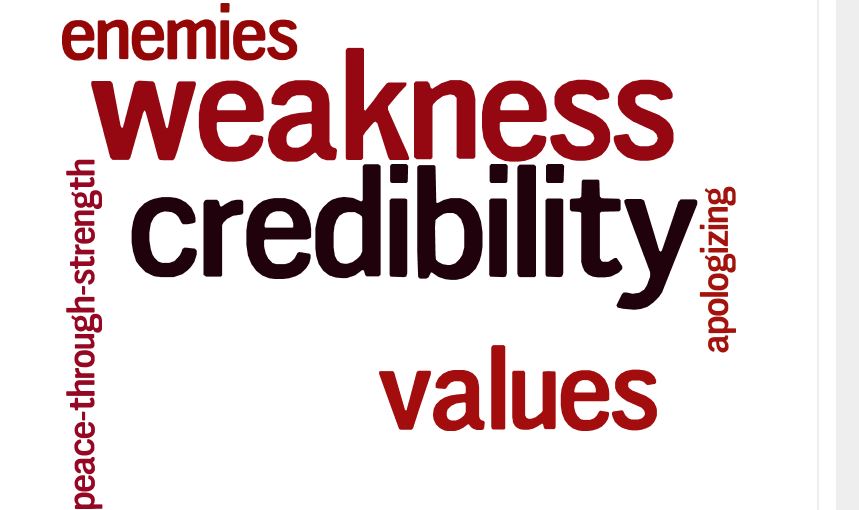
Two dominant Ryan word clusters emerged from the VP debate. (Wordclouds of each are based on the frequency of each word).  The first portion of the debate, centered on the Benghazi assault, brought the extreme bellicosity of the Romney-Ryan foreign policy to the fore. This is the word family clustered around “peace through strength”,  “no apology”, “projecting weakness”, “American Exceptionalism”, and “emboldening our enemies”. It is well and truly Roveian (that is, inherently two-faced by turning everything into its opposite)  insofar as it claims that its aim is peace (For example, Ryan saying “We want to prevent war,” when he was directly asked if he wanted a war), but the emotional weight and entire subtext is what can be characterized as the material and psychological martial law enforced by America, the world’s sheriff.

In the alchemy of this rhetorical compound, ordinarily neutral terms such as “values” and “credibility” are appropriated into the discourse of dominance. The rest of the world–the subservient Other–has no credibility and doesn’t share “our” values.

Because this position is inherently unstable and subject to threat, it’s  always working to seem invulnerable. It’s the mastermeme that sanctions an unending “war on terror,” a state of velvet but perpetual martial law. It is eternally vigilant, always defending whatever means it uses (waterboarding, drone strikes, military invasions) to justify the end.

This paranoid sense of threat explains Ryan’s obsession with “credibility” and with not “projecting weakness”.  The projection is all. There’s absolutely no rhetorical space for irony or tragedy. It can never, ever “apologize”. It is hubris personified.

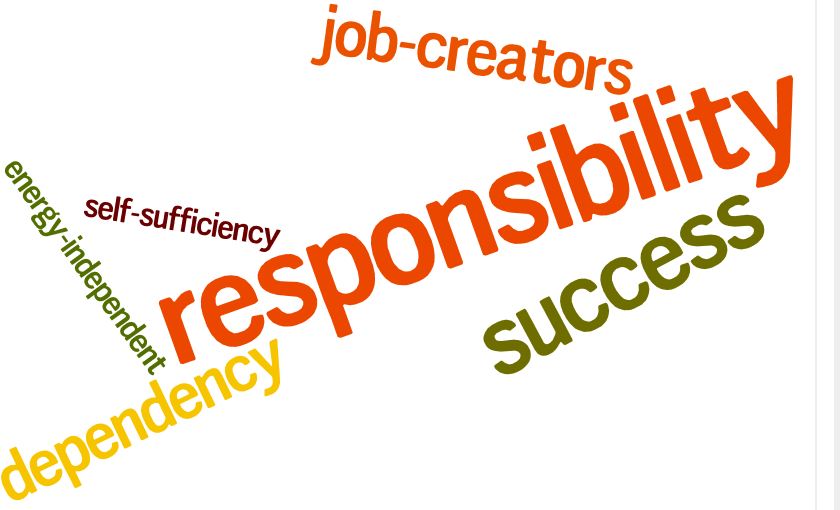
“Social Darwinism” is a second major Ryan meme, domestic cousin of the “martial law” meme:

Social Darwinism

This cluster (again, based on the number of times Ryan used each term in the debate)  stresses “self sufficiency”, “responsibility” and “making the tough choices”. It is a winner-take-all mentality, a Hobbesian materialism that is the diametrical opposite of Christian caritas. It eschews all dependencies–on the government, on foreign energy suppliers, on labor. It privileges the super-rich, rechristened and valorized as “job creators”. It is the only possible definition of “success“, so all else is, by implication, failure.

A taint of failure and thus scorn is rhetorically attached to anyone in opposition to any aspect of it. At best, dissenters from this orthodoxy are either dismissed as “special interests” (yet another neutral term that Roveianism appropriates, along with “values” “responsibility”, and even, astonishingly, “bi-partisaniship”) or as selfish “class warfare” crusaders hypocritically posing as humanitarians. The “heroes” of this meme are either Ayn-Rand titans of industry or “entrepreneurs” and “small businesses”. (Anyone but the workers themselvesof course). Although Ryan didn’t use the term “redistribution” in the debate, it is also part of the “failure” meme.

Both of these memes are deceptive and two-faced in their very DNA. They’re like deadly viruses, and Obama and Biden are running out of time to develop an antidote.

The Many Ryan Plans: Roadmaps to Nowhere

Romney and Ryan face the fundamental dilemma of not being able to straightforwardly say how they would govern because the truth would devastate their campaign. So they swerve and obscure and misdirect, or as The Economist once called them, “fudges and elisions, and the odd outright falsehood.”

The template for this fraudulence was forged in fire when Paul Ryan’s original economic “Roadmap For America’s Future” was floated in 2008, 2009 and then again in 2010. After the 2010 relaunch, Republican leaders quickly read the tea leaves on this socially draconian plan and began furiously backing away from it.

The pruned and tweaked 2012 version seems downright benign in comparison to its predecessors, yet, as David Stockman argued in an August, 2012 NY Times Op-Ed, “Paul Ryan’s Fairy-Tale Budget Plan,” the much-revised roadmap still leads to nowhere.

Key specific recommendations in the many Ryan plans, currently to be avoided at all costs:

  • the 8.5%  “business consumption tax” (intended to replace the corporate income tax)
  • the optional privatization of Social Security
  • the replacement of the health insurance premium exclusion with an indexed tax credit
  • the elimination of the estate tax and all investment income taxes
  • raising Medicare eligibility age to 69 by 2022

Click here for a comparison of the four Ryan Plans, by the Committee For A Responsible Federal Budget